
What Does It Mean When a Coach Views Your Profile?
You got the notification, or you checked your profile and saw it: a college coach viewed your profile.
It's natural to want to know what happens next. The honest answer is simpler — and calmer — than the notification makes it feel.
The Short Answer
A view means a coach opened your profile and took a look at what you put there.
That is a real step. Your profile did its first job: it got in front of a coach and got opened.
It is also only the first step. A view is not an offer, and it is not a rejection. It is the start of a coach evaluating you — nothing more decided than that, in either direction.
How the Coach Got There
How a coach found your profile changes how much a single view can tell you.
You may have sent the link yourself, in an email to that coach. A view that follows your own outreach means your outreach led to a look — the coach chose to open your profile after hearing from you.
A coach may have found you on their own, through a search or a recruiting database. That view started with the coach, not with you, which makes it a good sign that something in your basic information — your position, year, size, or stats — matched what they were looking for.
Or your name may have come from someone else: a high school or club coach, or another person a college coach trusts, passed it along. A view that starts with a recommendation carries that person's judgment behind it.
In every case, the view itself is the same action: the coach opened the page. What led them there is part of the context, and it is worth remembering which path it was before you decide what the view means.
What a View Can Mean
A single view sits at the start of a decision a coach has not finished making. From the outside, several very different outcomes look exactly the same at this point.
The coach may be interested and want to learn more. Your profile gave them a reason to keep your name on their list and look again later — at newer film, at updated stats, or in person.
The coach may still be deciding. Recruiting is comparison: a coach is looking at many athletes for a small number of places, and one look is rarely enough to sort that out. You may still be in the mix while they look at other athletes, other film, and what their program actually needs.
Or the coach may have looked and decided you are not a fit for their program. That happens, and it is normal. Fit runs both ways — level, position, year, and academics all have to line up — and a coach closing your file says nothing about the next program on your list.
All three are ordinary. One view, on its own, cannot tell you which one happened.
What a View Does Not Tell You
A notification proves a click. By itself, it does not prove much else.
It does not tell you how long the coach stayed. It does not tell you whether they watched your video, read your bio, or checked your grades. And it does not tell you where you stand compared with the other athletes they are looking at.
That gap is the hard part. A quick look that ends in a decision and a careful read that ends in real interest can produce the same single notification. Reading more into it than that — in either direction — is guessing.
The exception is the tool you used to share your profile. Some tools show you more than the fact that a view happened. If yours does not, work with what you actually know: a coach opened your profile. That is the fact. Everything else is a signal you still have to collect.
Stronger Signals Than a Single View
If you want to know where you stand, watch for what happens after the first look. Coaches who keep engaging are telling you more than a coach who looked once.
Stronger signs include:
- The coach comes back. A second or third view means your profile was worth returning to.
- They stay a while. A view that lasts minutes suggests a coach actually read your page or watched film; one that lasts a few seconds is more likely a quick first screen. Treat it as a hint, not a verdict — a page left open in a browser tab can look like a long visit, and a coach can also decide quickly. Time spent means the most when it repeats.
- They go deeper than the profile page. Watching your video is a bigger step than opening your profile alone.
- They follow you or save your profile in whatever system they use, so they can find you again easily.
- They reply. A personal response to your email moves things from evaluation to conversation.
- They invite you to a next step after you have already been in contact. For example, a recruiting questionnaire from a coach you have already spoken with, or an invitation to visit, carries more weight than the same thing sent cold.
Weaker signs are easy to mistake for these. A generic camp invite from a program you have had no contact with, for example, is usually just a camp invite. It does not, on its own, mean that program is recruiting you.
None of this is a scorecard. Think of it as a direction: one view means you are being evaluated; repeated, deeper contact is what being recruited starts to look like.
What to Do After a View
You cannot control what the coach decided. You can control what they find next, and what you do with your time.
Keep your profile complete and current. A coach who is still deciding may come back. New stats, recent film, and an up-to-date schedule give that second look something new to work with. A profile that has not changed gives them nothing to reconsider.
If you follow up, add something. A short message that brings new information — updated film, new stats, your upcoming schedule — gives a coach a reason to look again. That is a useful message at any point in the process, whether or not you know about a view.
Fill out that program's recruiting questionnaire. If the school has one and you are interested in the program, complete it. It puts your information in the place that program's coaches actually search.
Keep your other schools moving. One view is not a reason to pause everywhere else. Keep building your list, keep sending thoughtful outreach, and keep your options open until a program's interest is clear and mutual.
And if a school is not a fit for you, you do not have to chase it because a coach looked. A view does not create an obligation in either direction.
What Not to Do
A few moves feel responsive and work against you.
Do not message the coach to say you saw them view your profile. It puts the coach on the spot about an early, unfinished step, and it does not add anything they can use. If you write, write because you have something new to share — as above.
Do not bring up scholarship money off the back of a view. A view is far too early for that conversation, and raising it now can only make a coach step back.
Do not stop recruiting because one coach looked. One view at one program is one data point. Keep several conversations going until interest is clear and mutual.
Do not refresh and wait. Checking for the next notification will not change what happens next. Updating your film and reaching out to your next school will.
A Note on Silence
Sometimes a coach who is interested still does not reply — and the silence is not about you.
Contact rules limit when college coaches can reach out to athletes, and those limits vary. A coach may be able to look at your profile before they are able to start a conversation with you.
So treat silence after a view the same way you treat the view itself: as limited information. It is not a yes, and it is not a no. Keep your profile current, keep your outreach going to other programs, and let clearer signals — a reply, a return visit, a next step — do the talking when they come.
How This Works on VarsityBio
On VarsityBio, you do not wait for a view to happen somewhere inside a platform. You send the link yourself — and you send a different tracked link to each coach.
That changes what a view can tell you. When a coach opens the link you sent them, the view is recorded against that coach's link — so a view is tied to the coach you sent it to, not just counted somewhere.
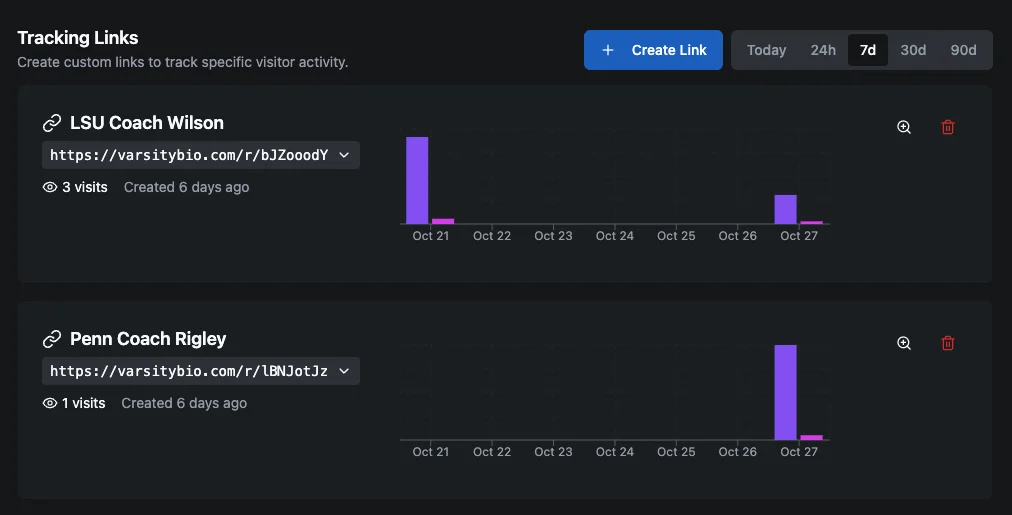
Here is the honest version of how the tiers work:
- A free account gets overall page-view analytics, plus 1 tracking link. That link tells you whether it was viewed and how many times — but not when it happened, where the view came from, or how long the coach stayed.
- Pro ($9/month) adds that detail — when each view happened, where it came from, and how long the page was viewed — plus more tracking links.
Send a Link You Can Track
One tracked link per coach, so a view tells you who looked. Build your free VarsityBio profile and send your link — Pro unlocks the full view details.
Get Started →That extra detail does not change what a view means — everything above still applies. It removes some of the guesswork: instead of knowing only that a view happened, you know when it happened and how long they stayed, and you can spend your follow-up effort where it is most useful.
The Bottom Line
A coach viewing your profile means you are being evaluated. That is the job you wanted your profile to do.
Your job now is to make the next look easy: a complete profile, current film, and a follow-up that adds something when you have something to add. Do that, keep your other options moving, and let stronger signals build over time.
Go Deeper
- What Coaches Look for in a Recruiting Profile — what a coach is scanning for during that first look at your profile.
- The Parent's Recruiting Checklist — the year-by-year checklist for parents helping an athlete through this process.
- How to Use Your VarsityBio Profile to Stand Out — how to make your profile worth the second look.
- Free Tools for Tracking College Outreach — simple ways to keep track of which coaches you have contacted and what happened next.